

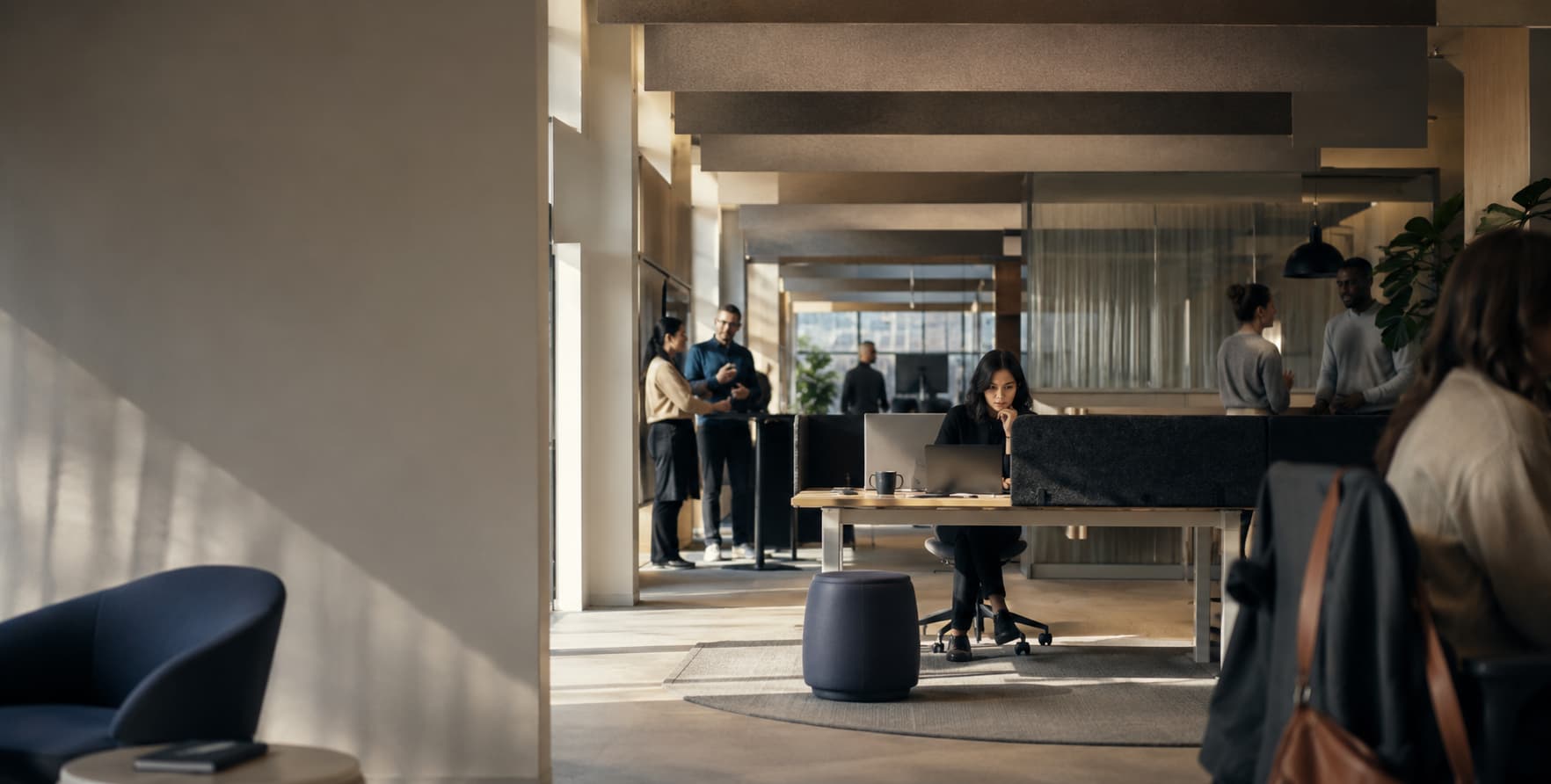
How acoustics, movement, and interruptions quietly shape workplace performance
A workplace does not need to be visibly dysfunctional to slow people down.
Often, the real problem is less obvious: a conversation that travels too far, a circulation path cutting through a focus area, or the lack of an appropriate space for a quick call. Individually, these moments seem insignificant. Repeated throughout the day, however, they create what we call spatial friction—environmental conditions that require people to spend additional attention simply to keep working.
When sound becomes cognitive work
Workplace noise is not always loud. In many cases, intelligible speech is more disruptive than overall sound level because the brain continues processing language even when the conversation is irrelevant.
A systematic review of open-office studies found that cognitive performance can begin to decline as surrounding speech becomes more intelligible. The effect is especially relevant to tasks involving working memory, reading, writing, and information processing. PubMed research on speech intelligibility
This is why acoustic comfort cannot be reduced to simply making a room quieter. The aim is to control how sound travels, how much speech can be understood across work zones, and whether people can choose an environment suited to their activity.
Recognising these differences, ISO 22955:2021 approaches open-office acoustics according to the activities performed within a space—from concentrated individual work to frequent calls and collaboration. There is no single acoustic condition that works equally well for every type of work.
The workspace also interrupts
Interruption is usually discussed as a digital issue: emails, messages, and notifications. But space can interrupt people too.
A colleague passing repeatedly behind a workstation, an informal discussion happening beside a focus desk, or someone searching for an available meeting room can all create moments of attentional switching.
Research consistently shows that interruptions introduce a resumption lag—the mental effort and time required to reconstruct where we were before the interruption. They can affect completion time, decision-making, accuracy, and the ability to resume complex tasks. Systematic review of interruption research
The interruption itself may be brief. Its cognitive after-effect is not always as brief.
Movement is not the problem. Unnecessary movement is.
Movement can support health, informal interaction, and collaboration. Spatial friction appears when movement is caused by poor alignment between space and activity.
Employees may need to relocate because the current area is too noisy, walk across the floor to find privacy, or repeatedly search for a suitable place to speak with colleagues. This is not productive mobility. It is a workaround.
The distinction matters. A well-planned workplace does not eliminate movement; it gives movement a clear purpose. Circulation should connect people and resources without repeatedly cutting through areas intended for concentration.
From open versus closed to fit versus friction
The conversation around workplace planning is often reduced to a binary choice: open plan or private office. In practice, performance depends on something more specific—whether people can access the right environmental conditions at the right moment.
A field study in an activity-based office found that moving cognitive work from an active zone to a quiet zone improved measured performance by 16.9%. Study on activity-based office environments
The implication is not that every task needs a closed room. It is that one uniform setting cannot effectively support every mode of work.
Reducing spatial friction requires an interconnected system:
Focus areas protected from circulation and intelligible speech
Collaborative settings positioned where conversation is expected
Acoustic materials selected as part of the spatial strategy
Enclosed spaces for calls, privacy, and concentrated work
Furniture that supports different postures and durations
Clear transitions that help people understand how each zone should be used
Designing for attention
The true performance of a workplace is not measured only by how many people it accommodates or how efficiently the floor plate is filled. It is also reflected in how easily people can concentrate, communicate, move, and recover throughout the day.
This requires looking beyond individual products. Acoustics, furniture, partitions, circulation, materiality, and user behaviour must work together as one spatial system.
At Vinoti, we see a great space as one that removes unnecessary friction while supporting the different ways people think, connect, and perform. Through integrated workplace solutions and partnerships with global and specialised brands, we help organisations create environments that work more intentionally for the people within them.
Because great spaces do more than accommodate people. They help great people do their best work.