

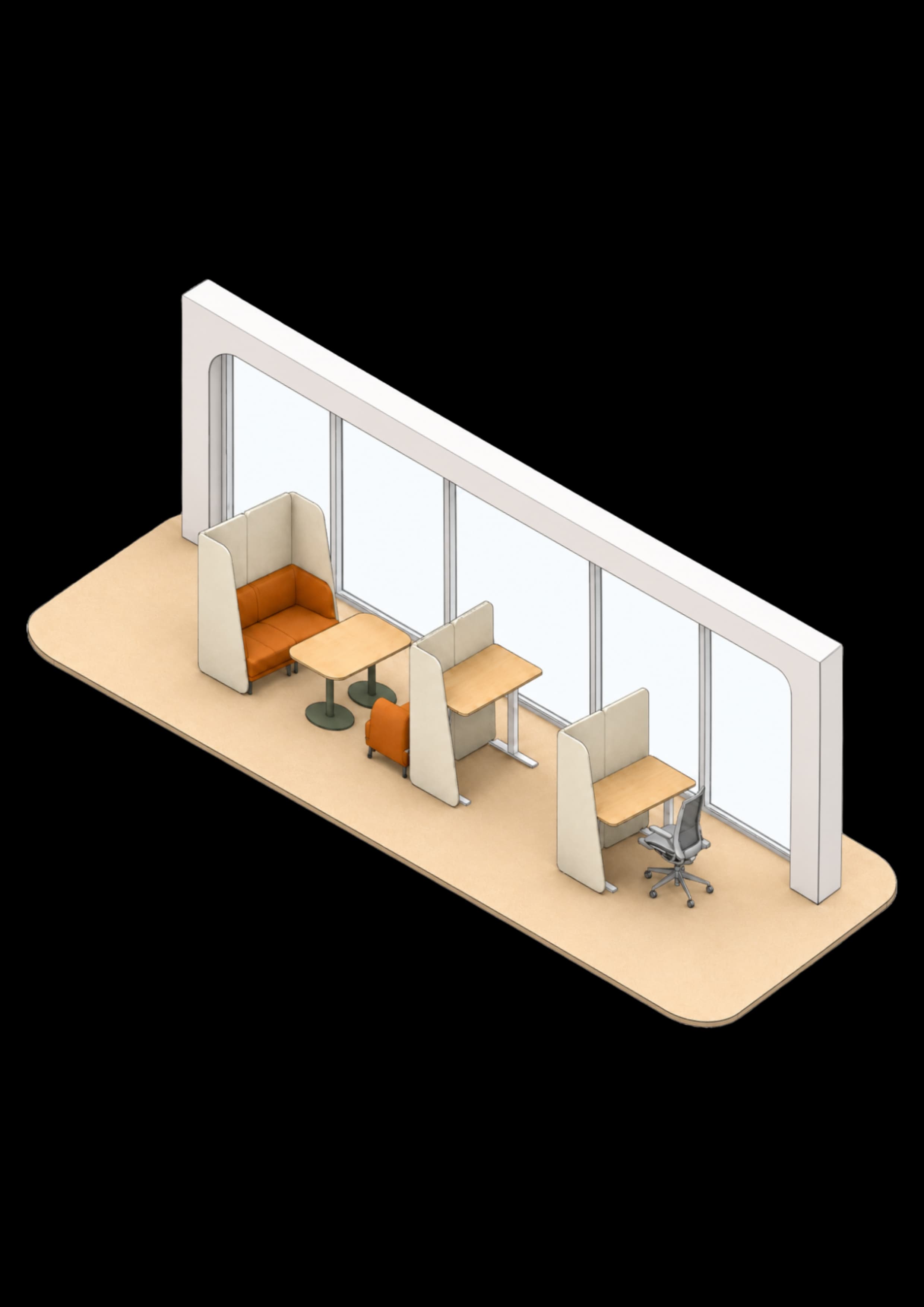
Pause • Exchange • Focus • Gathering
When we talk about office planning, the conversation usually starts with two things: workstations and meeting rooms. But in daily work, people do not only sit and attend meetings. They wait before a discussion starts. They take a quick call. They review something with a colleague for five minutes. They pause between tasks. They move from one mode of work to another.
These small moments often happen in the “in-between” areas of the office.
Today, workplace interiors are starting to pay more attention to these spaces. Not as leftover corners, but as part of the work system itself.
The Rise of the Office Third Space
A third space inside the office is not quite a desk, and not quite a meeting room. It can be a lounge area, a coffee bar, a semi-private seat, a shared long table, a corridor pause point, or a casual discussion zone.
These areas may look simple, but they answer a very real workplace need: not every conversation needs a booked room. A quick alignment can happen at a standing table. A relaxed exchange can happen near the coffee bar. A short pause can happen in a lounge corner. A focused call can happen in a semi-private area without disturbing the whole team. The office becomes more fluid when people have these options.
Why These Spaces Matter Now
Modern work is full of small transitions. People move between focused tasks, messages, video calls, team discussions, and short breaks throughout the day. Research on workplace experience continues to show the importance of giving people more choice in where and how they work.
This is where interior planning becomes important. A workplace with only desks and enclosed rooms can feel too rigid. People either stay at their desk for everything, or occupy a meeting room for something that does not really need one.
The result is familiar: meeting rooms are fully booked, open areas become too noisy, and people struggle to find a comfortable spot for quick work moments.
A better workplace gives each moment a place.
Designing for the Unscheduled
The most interesting parts of the office are often the least formal.
A coffee bar can become a place for casual exchange. A corridor can become a short pause point instead of just a circulation path. A lounge can support relaxed conversations that feel less pressured than a meeting room. A bleacher-style area can turn a quick team sharing into something more open and informal.
These settings work because they reduce friction. People do not have to plan too much, book too much, or move too far. The space simply supports what naturally happens during the workday.
Comfort Is Part of Productivity
The office is not only about efficiency. It is also about rhythm.
People need places to concentrate, but they also need places to step away. They need areas for collaboration, but also enough privacy to think clearly. They need spaces that support energy, and spaces that soften the day.
This is why elements like acoustic treatment, furniture proportion, seating posture, surface material, and zoning matter. They quietly shape how people use the office. A semi-private area can make a conversation feel protected without closing it off. A shared table can invite casual working without turning into a formal meeting. A lounge can make waiting time feel intentional. A well-placed acoustic panel can make an open area more comfortable without changing the whole layout.
Small details can change how the entire workplace feels.
Beyond the Floor Plan
The modern office is becoming less about filling space, and more about understanding behavior.
Where do people naturally gather? Where do they need privacy? Which areas create noise? Which corners are underused? Which moments of the day need better support?
These questions help turn the office from a static layout into a living system.
For workplace interiors, the opportunity is not always in making something bigger or more complex. Sometimes, it is in designing the overlooked spaces with more intention.
Because the workplace is not only built around where people sit. It is also shaped by where they pause, exchange, focus, and gather.